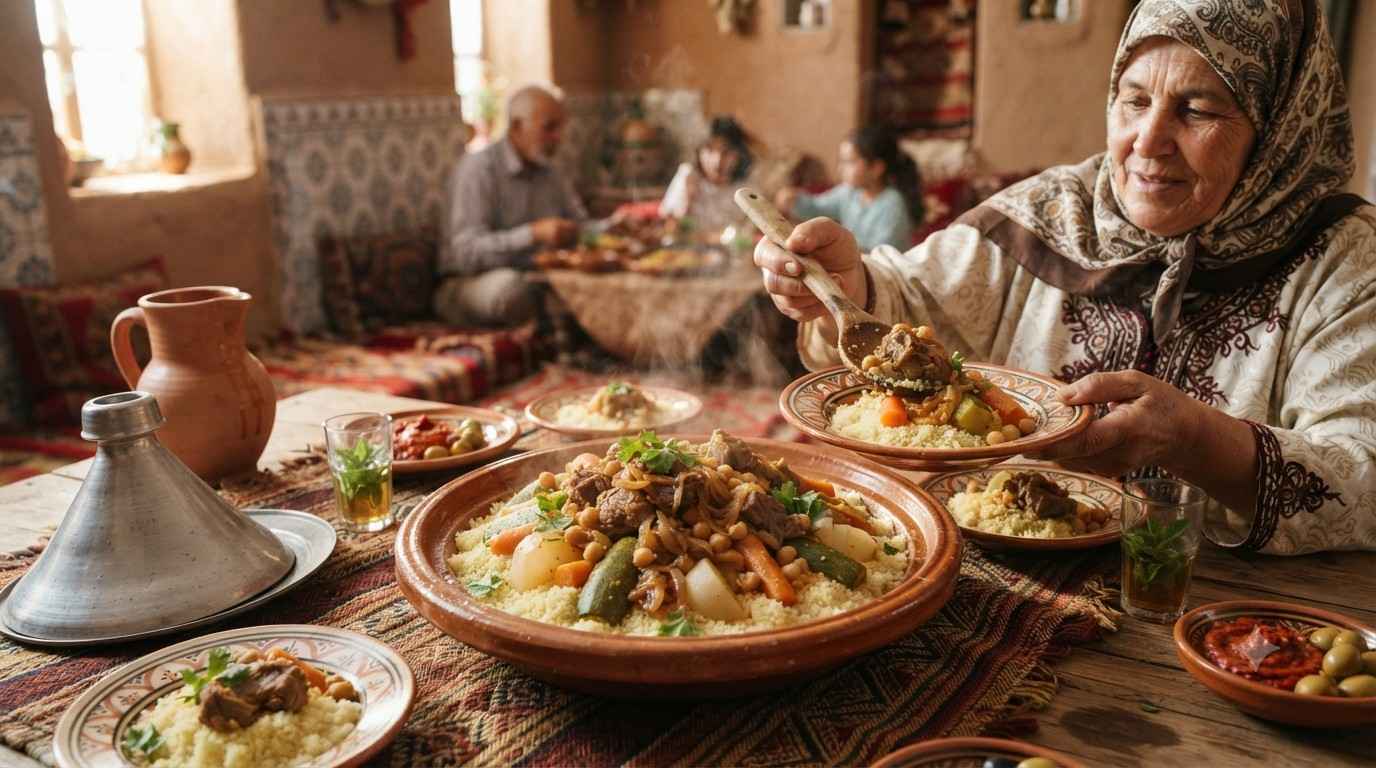
Couscous is far more than a simple grain-based dish in Algeria. It is one of the country's most recognizable foods and an important part of Algerian culinary culture. Made from tiny steamed grains of semolina and traditionally served with vegetables, chickpeas, meat, and a flavorful broth, couscous can bring an entire family around the same table.
Although couscous is eaten throughout North Africa, Algerian couscous has its own regional styles, ingredients, serving traditions, and preparation methods. From everyday family meals to Friday lunches, weddings, religious celebrations, and gatherings with guests, couscous often represents hospitality, generosity, and togetherness.
Understanding how couscous is served in Algeria means looking beyond the ingredients. The way it is prepared, arranged, shared, and eaten tells an important story about Algerian culture.
What Is Algerian Couscous?
At its simplest, couscous consists of small granules made from semolina, usually produced from durum wheat. The grains are traditionally steamed rather than simply boiled. This gives couscous its characteristic light, fluffy texture.
In Algeria, couscous is generally served as the base of a complete meal. The steamed grains are combined with a rich sauce or broth and accompanied by ingredients such as:
- Carrots
- Turnips
- Zucchini
- Potatoes
- Chickpeas
- Onions
- Tomatoes
- Various spices
- Lamb or mutton
- Chicken
- Beef
- Sometimes vegetables alone
The exact combination varies considerably depending on the region, household, season, and occasion.
This regional diversity is one of the reasons there is no single recipe that can be described as "Algerian couscous." Instead, there are many interpretations of the dish.
Couscous as a Social Meal
One of the most important things to understand about couscous in Algeria is that it is often a shared meal.
Rather than preparing an individual plate for every person, couscous may be arranged on a large communal serving dish. Family members sit together and eat from the same platter, traditionally using the right hand when eating by hand.
This style of dining encourages conversation and interaction.
The meal is not simply about satisfying hunger. It creates an opportunity for family members to spend time together.
For many Algerian families, couscous is particularly associated with the Friday meal. After the midday prayer, families may gather for a substantial lunch featuring couscous. While customs vary from household to household, the association between Friday and couscous is deeply familiar in Algerian food culture.
How Couscous Is Traditionally Prepared
The traditional preparation of Algerian couscous is considerably more involved than simply adding hot water to packaged couscous.
A traditional couscoussier is often used. This consists of two main sections:
- A lower pot where the broth or stew cooks.
- An upper steaming basket where the couscous is steamed.
The process allows steam from the cooking broth to rise through the couscous.
Step 1: Preparing the Semolina
The couscous grains are moistened with water and worked carefully so that the grains remain separate.
Traditionally, preparing couscous requires patience and experience. The goal is to create grains that are light rather than sticky or clumped together.
Step 2: Steaming
The couscous is placed into the upper part of the couscoussier.
Steam rises from the broth below and gently cooks the grains.
The couscous may be removed, worked again, moistened, and returned to the steamer several times.
This repeated steaming contributes to the characteristic texture associated with traditional couscous.
Step 3: Preparing the Broth
At the same time, the lower pot is used to prepare a stew or broth.
Depending on the recipe, it can contain meat, vegetables, chickpeas, tomatoes, onions, spices, and other ingredients.
The broth is extremely important because it provides much of the flavor that eventually reaches the couscous.
Step 4: Combining Everything
Once the couscous is properly steamed, it is transferred to a large serving dish.
The grains are loosened and arranged before the vegetables and meat are placed on top.
Finally, the flavorful broth is added carefully.
The result is a large, colorful platter designed to be shared.
What Goes on Algerian Couscous?
There is no universal ingredient list because Algerian couscous differs across regions and households.
However, several ingredients appear frequently.
1. Semolina Couscous
The foundation is steamed semolina couscous.
Good couscous should be fluffy and separated rather than wet and heavily compressed.
Its relatively neutral flavor makes it ideal for absorbing the broth and juices from the accompanying ingredients.
2. Vegetables
Vegetables are an important part of many Algerian couscous preparations.
Common choices include:
- Carrots
- Turnips
- Zucchini
- Potatoes
- Pumpkin or squash
- Cabbage
- Onions
- Tomatoes
The vegetables are typically cooked in the broth, allowing them to absorb its flavors.
Different vegetables may be emphasized depending on the season and region.
3. Chickpeas
Chickpeas are another familiar addition.
They provide a pleasant contrast to the soft couscous and cooked vegetables while adding texture and substance.
They are often cooked directly in the stew so that they absorb the flavors of the broth.
4. Meat
Meat can turn couscous into an especially substantial meal.
Depending on the household and occasion, couscous may be served with:
- Lamb
- Mutton
- Beef
- Chicken
Lamb and mutton are particularly associated with celebratory and traditional versions.
The meat is generally cooked in the stew or broth and eventually placed on top of the couscous when the dish is assembled.
The Importance of the Broth
The couscous grains themselves are relatively mild.
The broth is what transforms them into a deeply flavorful meal.
After the couscous has been steamed, the broth may be poured over the grains. Some families add the liquid gradually, allowing the couscous to absorb the flavor without becoming excessively wet.
Additional broth can be served separately so that people can add more according to their preference.
This is one reason the same couscous can taste quite different from one household to another.
The vegetables, meat, tomatoes, onions, spices, and cooking method all influence the final broth.
Red Couscous and White Couscous
Algerian couscous can have different appearances depending on how it is prepared.
One common distinction is between couscous with a redder sauce and lighter versions.
Red Couscous
A tomato-based broth can give the dish a warm reddish or orange appearance.
It is often rich, aromatic, and deeply savory.
White or Lighter Couscous
Some preparations use a lighter-colored broth and may rely less heavily on tomatoes.
These versions can have a more delicate appearance while still being flavorful.
The choice is not simply about appearance. It can reflect regional traditions and family preferences.
Regional Differences Across Algeria
Algeria is enormous geographically, and its cuisine reflects that diversity.
Couscous is prepared across the country, but recipes and serving styles can vary between regions.
In northern Algeria, Mediterranean influences can be noticeable in ingredients and cooking styles.
In Kabylie, regional traditions may feature distinctive combinations of grains, vegetables, and sauces.
In the highlands and interior regions, heartier preparations can be common.
In southern Algeria, local ingredients and Saharan culinary traditions influence how couscous is prepared.
This diversity is important because calling one particular recipe "the Algerian couscous" can overlook the country's enormous culinary variety.
How Algerian Couscous Is Served
Once the couscous is ready, presentation becomes an important part of the meal.
Traditionally, the couscous is placed on a large serving dish.
The grains form the base.
Vegetables are arranged over and around the couscous.
Meat is generally positioned prominently, often toward the center or on top.
Chickpeas may be distributed across the dish.
Finally, broth is added.
The resulting platter is visually impressive: pale golden grains are surrounded by colorful vegetables, tender meat, and a rich sauce.
For a family gathering, the platter may be placed in the center of the table so everyone can share.
Eating Couscous From a Communal Platter
Traditional communal eating is an important part of the cultural experience.
When couscous is eaten from a shared platter, diners generally take food from the section closest to them rather than reaching across the entire dish.
This makes the meal orderly and considerate.
When eating by hand, diners use the right hand and gather small portions of couscous, sometimes shaping them gently before eating.
However, modern Algerian households are not limited to one method. Many people also eat couscous using spoons or forks, particularly depending on the household, setting, or personal preference.
The communal platter remains an important symbol of togetherness even when modern utensils are used.
Couscous and Algerian Hospitality
Hospitality is an important part of Algerian social life, and food plays a major role in welcoming guests.
Couscous is particularly suitable for entertaining because it can be prepared in a large quantity and served as a generous centerpiece.
When guests arrive, preparing a substantial meal communicates care and generosity.
A large couscous platter can therefore represent much more than food.
It can say:
You are welcome here.
The time involved in preparing traditional couscous also contributes to this feeling. Preparing the grains, cooking the broth, steaming the couscous, arranging the vegetables, and presenting the finished dish requires effort.
Serving it to guests demonstrates that effort.
When Is Couscous Served in Algeria?
Couscous can be eaten throughout the year, but certain occasions make it especially significant.
Friday Lunch
Friday is strongly associated with couscous in many Algerian households.
After the Friday prayer, families may gather for lunch, making couscous a traditional centerpiece.
For some families, Friday couscous is almost a weekly ritual.
Family Gatherings
When extended family members come together, couscous can be an ideal meal because it is naturally suited to communal dining.
A large platter allows everyone to participate in the meal together.
Weddings and Celebrations
Couscous may also appear at weddings, religious celebrations, and other important social events.
Celebratory versions can be particularly generous, featuring larger quantities of meat and a wide variety of ingredients.
The presentation may also be more elaborate than an everyday family meal.
Religious and Cultural Occasions
Food traditions can become especially meaningful during important religious and cultural occasions.
Couscous may be prepared as part of gatherings where relatives and friends come together.
The specific customs differ between families and regions, but the central idea remains: food creates a shared experience.
Couscous as Comfort Food
For many people, couscous is also connected to home.
The smell of steaming semolina, vegetables cooking in broth, and spices filling the kitchen can evoke memories of family meals.
This is one reason couscous remains relevant even as Algerian lifestyles change.
A person may live in a modern city, work a demanding job, and eat many international foods during the week, yet still associate a traditional couscous meal with home and family.
Food traditions survive not only because people follow recipes, but because they carry memories.
What Makes Algerian Couscous Different?
Algerian couscous shares a broad culinary heritage with other North African countries, including Morocco and Tunisia.
However, each country has developed its own regional interpretations.
Algerian couscous is characterized by enormous internal diversity.
Some versions are heavily vegetable-focused.
Others emphasize meat.
Some are tomato-rich and deeply colored.
Others use lighter sauces.
Some are everyday dishes.
Others are associated with major celebrations.
Therefore, rather than thinking of Algerian couscous as a single fixed recipe, it is better to think of it as a family of related dishes connected by steamed semolina, flavorful cooking, regional ingredients, and communal traditions.
The Role of Spices
Spices help define the character of Algerian couscous.
Depending on the regional recipe, cooks may use combinations of ingredients such as:
- Black pepper
- Cumin
- Coriander
- Paprika
- Cinnamon
- Turmeric
- Ginger
- Chili
- Ras el hanout or other spice blends
The exact seasoning is highly variable.
The objective is generally not to make the dish overwhelmingly spicy. Instead, spices build layers of aroma and flavor in the broth.
This allows the couscous to remain the mild foundation while the stew provides complexity.
Harissa and Extra Heat
For diners who enjoy heat, chili-based condiments can accompany couscous.
Harissa is particularly well known throughout North African cuisine.
Rather than making every portion extremely spicy during cooking, serving a spicy condiment separately allows each person to control the level of heat.
This approach is especially useful when a family meal includes people with different preferences.
One person can enjoy a mild bowl of couscous while another can add plenty of chili.
The Art of Getting the Texture Right
One of the most important aspects of good couscous is texture.
Poorly prepared couscous can become:
- Sticky
- Heavy
- Mushy
- Dry
- Clumped together
Traditionally prepared couscous aims for grains that are light, tender, and separated.
This is one reason experienced cooks pay attention to steaming and hydration.
The grains need enough moisture to become tender, but not so much that they turn into a paste.
Traditional preparation can involve several steaming stages, with the couscous being removed and worked between them.
For experienced cooks, achieving the right texture is part of the craft.
How a Traditional Couscous Meal Comes Together
Imagine an Algerian family preparing couscous for a Friday lunch.
The preparation may begin hours before the meal.
The semolina is prepared and steamed.
Meanwhile, a pot of meat, vegetables, chickpeas, onions, tomatoes, and spices slowly develops into a rich broth.
The couscous is steamed again and carefully loosened.
When everything is ready, the couscous is arranged on a large platter.
The vegetables are placed carefully across the grains.
The meat becomes the centerpiece.
Chickpeas are distributed throughout.
The broth is added.
Everyone gathers around the table.
What began as separate ingredients has become one communal dish.
That transformation is an important part of what makes couscous culturally significant.
Couscous Is More Than a Recipe
It is tempting to understand traditional foods by looking only at their ingredients.
But couscous demonstrates why food culture is more complicated.
A recipe tells you what goes into a dish.
Tradition tells you when, why, how, and with whom it is eaten.
In Algeria, couscous can represent:
- Family
- Hospitality
- Celebration
- Generosity
- Regional identity
- Tradition
- Community
- Home
Its importance comes from all these elements working together.
Modern Algerian Couscous
Although traditional preparation remains important, Algerian cuisine is not frozen in time.
Modern families may adapt recipes based on:
- Available ingredients
- Cooking time
- Personal preferences
- Dietary requirements
- Modern kitchen equipment
- Family traditions
Some households use modern steaming equipment.
Others purchase ready-made couscous and simplify preparation.
Some people eat couscous individually rather than from one communal platter.
These changes do not necessarily mean that the tradition has disappeared.
Instead, they demonstrate how food traditions can adapt while retaining their cultural identity.
How to Experience Algerian Couscous Properly
If you want to understand Algerian couscous, tasting the dish is only part of the experience.
Pay attention to the entire meal.
Notice how the couscous is prepared.
Look at how the vegetables are arranged.
Taste the broth separately.
Compare the flavor of the grains before and after they absorb the sauce.
Notice how the meat and vegetables complement the semolina.
Most importantly, experience it as a shared meal whenever possible.
The communal aspect helps explain why couscous has remained so important for generations.
Final Thoughts
How couscous is served in Algeria is ultimately a story about much more than food.
The dish begins with simple semolina grains but develops into something much richer through steaming, slow-cooked broth, vegetables, chickpeas, meat, spices, and careful presentation.
It may appear on an ordinary family table or at a major celebration. It may be served in different regional styles, with different vegetables, sauces, meats, and seasonings. Yet the central idea remains remarkably consistent: couscous brings people together.
A large platter placed in the middle of a table creates a natural gathering point. Family members share the meal, guests are welcomed, and traditions are passed from one generation to the next.
That is why Algerian couscous should not be viewed simply as a recipe.
It is a meal, a tradition, a symbol of hospitality, and an important part of Algeria's culinary identity.
From the first steaming of the semolina to the final spoonful of flavorful broth, Algerian couscous represents the idea that some of the most meaningful foods are not just meant to be eaten—they are meant to be shared.